

Celebrating Heritage Months
Hispanic Heritage Month is upon us. As we prepare to move into another month where we recognize the heritage of our Hispanic colleagues, families, and children, I began thinking about what it means to truly celebrate each heritage month. How can we deeply appreciate our diverse worlds and workplaces without falling into the stereotypical tropes and misnomers that end up offending an entire group of people?
In the U.S. we have started to nationally recognize the different heritages and cultures that make up the U.S. population, which I am profoundly grateful for. However, as a Black woman, I think about how Black History Month is historically celebrated, and I do not wish the same for other BIPOC heritage months that get added to our national calendar.
Let me clarify that. Historically, Black History Month would only celebrate the contributions of a few Black Americans from our past and a few in our present. This may include Martin Luther King Jr., Rosa Parks, Frederick Douglass, and other Black figures that made amazing contributions to this country. The problem is, we would only learn about those figures. We would learn about the figures whose advocacy methods made everyone comfortable. When we celebrate Black figures who are alive, we celebrate the achievements of our entertainers and athletes.
And while we have a deep love for these amazing figures, it is not all that we are made up of. When you continuously teach or celebrate the same people or types of people, it minimizes the contributions of people who were not sensationalized by mass media. It leaves behind people of that heritage that are making contributions to the future of medicine, agriculture, technology, architecture, and education.
So how do we celebrate heritage months and avoid offending those who make up that culture? I had the chance to speak to three women of color, CDA Professional Development (PD) Specialist™ Dr. Angela-Perla Almodovar, Katorra Enoch-Longshore, Director of Credentialing at the Council, and Vilma Williams, Multilingual and Special Programs Manager, on their views on what it means to truly celebrate heritage month.

Why do we celebrate heritage months?
According to Lewis and Clark College, celebrating heritage month is a time to provide recognition of the complexions and richness of each cultural identity. Celebrating diverse heritages allows us to take a moment to acknowledge every aspect of a specific heritage, the contributions of their people, their traditions, and their cultural norms. This is also a time to raise awareness about their issues, their histories, and the ways they are continually oppressed or marginalized in society today.
What does it mean to celebrate heritage month?
“Celebration of heritage definitely for me translates into how we are,” says Katorra who uses a variety of ways to describe what celebrating means to her. She spoke to recognition, empowerment, and preservation as a means of celebrating each other’s heritage and culture. One word that stood out to me was preservation. The preservation of cultural assets.
Cultural heritage preservation means keeping the traditions and artifacts of the community intact despite factors that may be trying to change them (The Borgen Project). Preserving cultural heritage traditions and artifacts is one way to truly celebrate another heritage. Not only by keeping those traditions and cultural norms in place, but also extends to the education and learning of that heritage.
For Vilma, that is exactly what celebrating heritage month means to her. She believes it is a space to teach and learn about history. This is why it’s so important to reflect during this time. On the contributions, the richness of culture, and the achievements that have been made. Hispanic Heritage Month is a personal time for Vilma to pass posterity to her children and grandchildren and inject them with the pride of her people.

What does celebrating look like?
In the child care setting
For Dr. Angela-Perla, celebrating is not done in just one day or one month, but every day. Especially in child care settings. Asking parents to bring food from their country or listening to their music is not the celebration, it’s just part of it. For Dr. Angela-Perla, it’s important to “encourage the children and deliver the message that we know who you are and we're going to celebrate you the whole day.” One practice she used when working in her center was asking parents to bring in a flag of their country. She would then post the flag on the walls and write the name of the children that belonged to that culture. This was an everyday practice, embedded in the curriculum of her center.
Reflecting on her past experiences in the classroom, Katorra states that the celebration of heritage in the child care setting should be intentional and individualized to represent the children and families. This can be done by continuously asking for input from the families. Engaging in reflective practice, not just on the first day, but ongoing input to inform how they would like to be represented in the classroom. Heritage months provide an opportunity to acknowledge other cultures, and the celebration of the children and family's culture should also be happening outside of these designated times.
In the workplace
In the workplace, celebrating diversity and other heritages are going to look vastly different. As an employee, I’m not looking for my employer to send out one email in recognition of heritage and that is it. Celebrating diversity is less about the surface-level recognition of my heritage, but diving much deeper into who I am and what aspects of my culture and my experiences makeup who I am.
For Katorra, who has been tasked with expanding DEI efforts in the Council, she is looking to make the workplace psychologically safe. According to the nonprofit organization, the Center for Creative Leadership, psychological safety is the belief that you won’t be punished for speaking up on ideas, questions, concerns, or mistakes (Leading Effectively Staff, 2022). To Katorra, this means creating a safe space for employees to share their thoughts without retaliation.
What to avoid when celebrating heritage months?
When celebrating heritage months, there are things you can avoid doing to not offend a group of people. This includes avoiding misnomers and misinterpretations of traditions. Dr. Angela-Perla pointed out that a holiday tradition may be celebrated very differently depending on the socio-economic background of that family. These may not be minor differences, but an entirely different way the tradition is practiced in the home.
One of the biggest traps that people fall into when celebrating heritage months is perpetrating stereotypes. This can be due to not fully educating oneself on the distinct aspects of a culture or heritage. One concept that can help individuals avoid stereotypes is called cultural humility. The American Psychological Association describes cultural humility as a practice that requires us to be “humble and flexible, bold enough to look at ourselves critically and desire to learn more” (Waters & Asbill, 2013).
We all have unconscious biases. How we move the needle forward is by accepting that we all have biases and intentionally acting in ways that counteract implicit biases. The American Journal of Medicine established a coaching framework called the “5 Rs of Cultural Humility” (Robinson et al, 2020). The 5 Rs include Reflection, Respect, Regard, Relevance, and Resiliency. Though these 5 Rs were established for the hospital, this framework can also be extended to organizational culture and teaching staff. The image below shows how to use the 5 Rs.
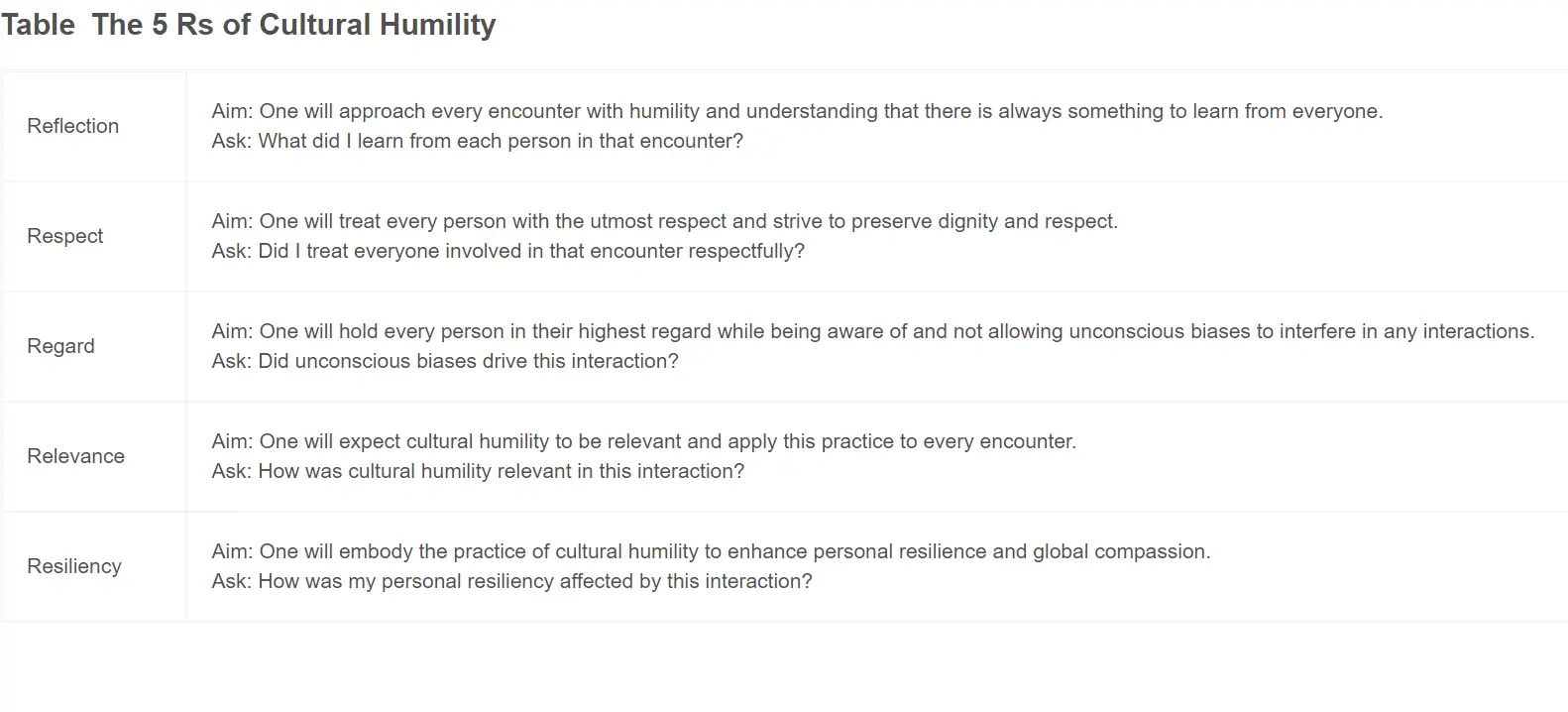
I think if each of us can make an intentional decision to call out our own biases and be open to learning more about other people and acknowledge the diverse cultural aspects and experiences that make someone who they are. At that point, we can truly celebrate each heritage month in a way that truly reflects, recognizes, and empowers people.
For more resources on cultural humility, check out the following:
The 5 Rs of Cultural Humility: A Conceptual Model for Health Care Leaders
Unpacking Biases: Developing Cultural Humility in Early Childhood and Elementary Teacher Candidates
Cultivating Cultural Humility in Education
About the author: Alecia Carter is the Credentialing Academy Coordinator for the Council for Professional Recognition. She has worked in the early childhood field for 9 years, starting at the National Association for the Education of Young Children (NAEYC) where she developed her passion for providing equitable high-quality education for children. Alecia has also developed a passion for writing and design, which she gets to dabble in when creating posts and other content for the Council Alumni Network.