

Mind Over Matter: Prioritizing the mental wellbeing of our early childhood educators.
Written by: Maisah Williams-Foote
The word “matter,” when used as a verb, means “be of importance, have significance.” When asked what “matters” in early childhood, the response often involves the benefits of high-quality early childhood education. Research supports that children who experience quality early learning and care programs, as published on the Start Early website, are:
- 25% more likely to graduate high school.
- 4 times more likely to have completed a bachelor’s degree or higher.
- Earn up to 25% more in wages as an adult.
All these elements matter.
In addition to the advantages of high-quality early childhood education mentioned earlier, brain development in the early years is crucial. In the first few years of a child’s life, laying the groundwork for their future health and development is crucial. A key factor in this is the rapid growth of the brain, which kicks off even before they are born and keeps going strong into early childhood. The first eight years are the most impactful.
Recognizing this significance and why early childhood matters, the continued dedication to increasing funding for early childhood programs such as Head Start is no surprise. On March 23, 2024, President Biden signed the Further Consolidated Appropriations Act, 2024 (P.L. 118-47), increasing funding for programs under the Head Start Act (the Act) to $12,271,820,000, which represents an increase of $275 million over FY 2023.
The Masai, an ethnic group in Africa, traditionally greet each other with “Casserian Engeri,” which means, “And how are the children?” Their traditional greeting embodies their belief that the condition and future of the next generation guide community wellness, stability, and prosperity. According to the documented benefits and increased funding, our children are doing better than the generations before them.
However, the response may differ if we revise the greeting to " How are the early childhood educators?”, especially about their mental and emotional well-being.
I am beginning with low wages.
Early childhood educators continue to receive low wages. Despite the recent impetus of the early childhood industry to increase salaries for this critical profession, early childhood professionals’ compensation consistently falls below a living wage.
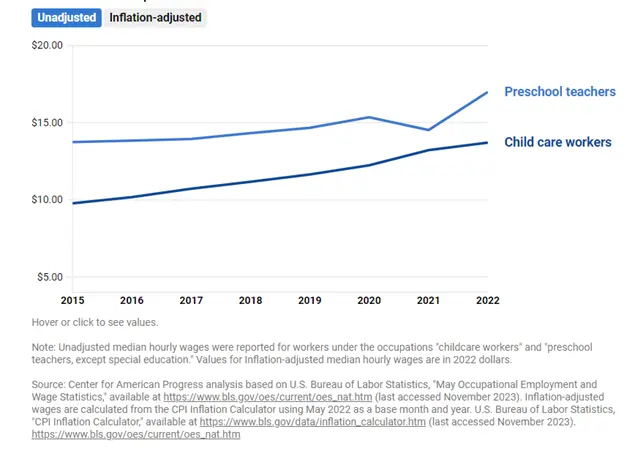
The below chart indicates wages for childhood educators including the median wages of child care and preschool teachers from 2015-2022.
In addition to low wages, the Economic Policy Institute in the United States found disparities in employer benefits. “While 52.2% of all workers have employer-sponsored health coverage, only 20.7% of child care workers do.”
The same study found that women make up 94.0% of the childcare workforce and women of color make up 40.9%.
Low wages and dismal access to health care benefits, while navigating the realities of being a woman of color in the United States and serving in a challenging yet rewarding profession, address the decline in mental health and wellness for educators. According to the Office of Child Care, “recent surveys of the ECE workforce identify significant proportions of staff experiencing mental health issues. One study found that 66 percent of ECE staff surveyed experienced moderate-to-high stress levels.”
The increase in elevated levels of stress is indicative of financial insecurity due to low wages, the inability to access health care for physical and mental well-being, and too often serving as a caregiver for children experiencing trauma.
So, let us ask, “How are the children?” with a new response, “As well as their early childhood educators and caregivers.” We must examine the intersectionality of the well-being of our children with the well-being of the person responsible for their care outside of their parents and guardians.
According to an article published by Zero to Three, Early Childhood Teachers’ Well-Being” What We Know and Why We Should Care, a study found that “the psychological distress (i.e., depressive symptoms) Early Head Start teachers experience was directly associated with their reports of children’s behavioral problems and the quality of emotional and behavioral support they provide to children. The researchers speculated that the direct association between teachers’ depressive symptoms and toddlers’ behavioral problems suggests that the children may react to and learn from teachers’ negative moods, behavioral modeling, and poor self-regulation resulting from their psychological stress. Also, teachers who feel depressed are less likely to provide positive emotional and behavioral support to children because the depressive symptoms may hinder their ability to serve as positive emotional and behavioral models, limiting their ability to provide warm and nurturing care.”
Now let us revisit this blog’s title: Mind over Matter. This phrase often describes a person’s ability to control problems, such as physical pain or life hardships, using their mind. However, for a person to accomplish this, they must possess a healthy mind. A mind capable of facing life challenges healthily. Our early childhood educators face the difficulty of rectifying the mental strain associated with the profession they love, for what matters is the well-being of the children they love.
But at what cost? Often at the expense of their well-being.
Early childhood champions and thought leaders echo the importance of early childhood education. We know its value, and despite the societal, financial, and cultural implications on women, and especially BIPOC women, we remain steadfast. We encourage the next generation to enter the field, realizing that it may lead to a life of financial hardship. We demand additional government funding to address the decline of available ECE services, pointedly in under-resourced communities and child care deserts, understanding these efforts may result in an under-staffed and over-worked workforce. Why? Because early childhood matters!
How can we continue to advocate for high-quality early childhood education while demanding an equitable, mentally, emotionally safe, and just workforce for our educators? We make decisions and execute policies with their mental well-being in mind.
Beyond the obvious, higher compensation and quality health benefits are also factors to consider.
- Program Design: What is the appropriate child/educator ratio for a healthy environment for both the children and educators? Are educators expected to be fully present, attentive, intentional, and emotionally safe for too many children at once?
-
ECE Spaces: When designing an ECE space, classroom, building, or center, how much of the space is dedicated to educator well-being? Is there space for reflection, relaxation, planning, and belonging with other educators?

-
Mental Health Services: How can we ensure all educators have access to mental health services, such as therapy from culturally responsive practitioners? Consider resources like the National Head Start Association-sponsored Starling Minds, a self-guided digital program available 24/7 for Head Start educators, or investing in a membership to apps like Calm for all staff. Financing an educator-led wellness program for free resources and activities during work hours, such as weekly yoga, meditation, and massage chairs.
-
Reimagine Pre-service and Staff Training: Design professional development opportunities with mental health and well-being in mind. Adults benefit from play and relaxation. Consider inviting an organization like the Playmaker Project to your next staff in-service to provide play-based, wellness-infused experiences in your annual staff training.
High-quality early childhood education can coincide with an equitable, inclusive, healthy, supported, and valued workforce. Respectfully, the factors surrounding higher wages and benefits are nuanced, and the fight continues, but this does not excuse our field from using the resources and assets we possess now to address the mental health and well-being challenges present in our field.
We must place the “mind” over the tangible outcomes we desire to achieve our goal of a safe, loving, kind world for our children and the adults who educate them and mold their futures.
Be mindful.