
Early talk is an equity issue
By: The LENA Team, https://www.lena.org
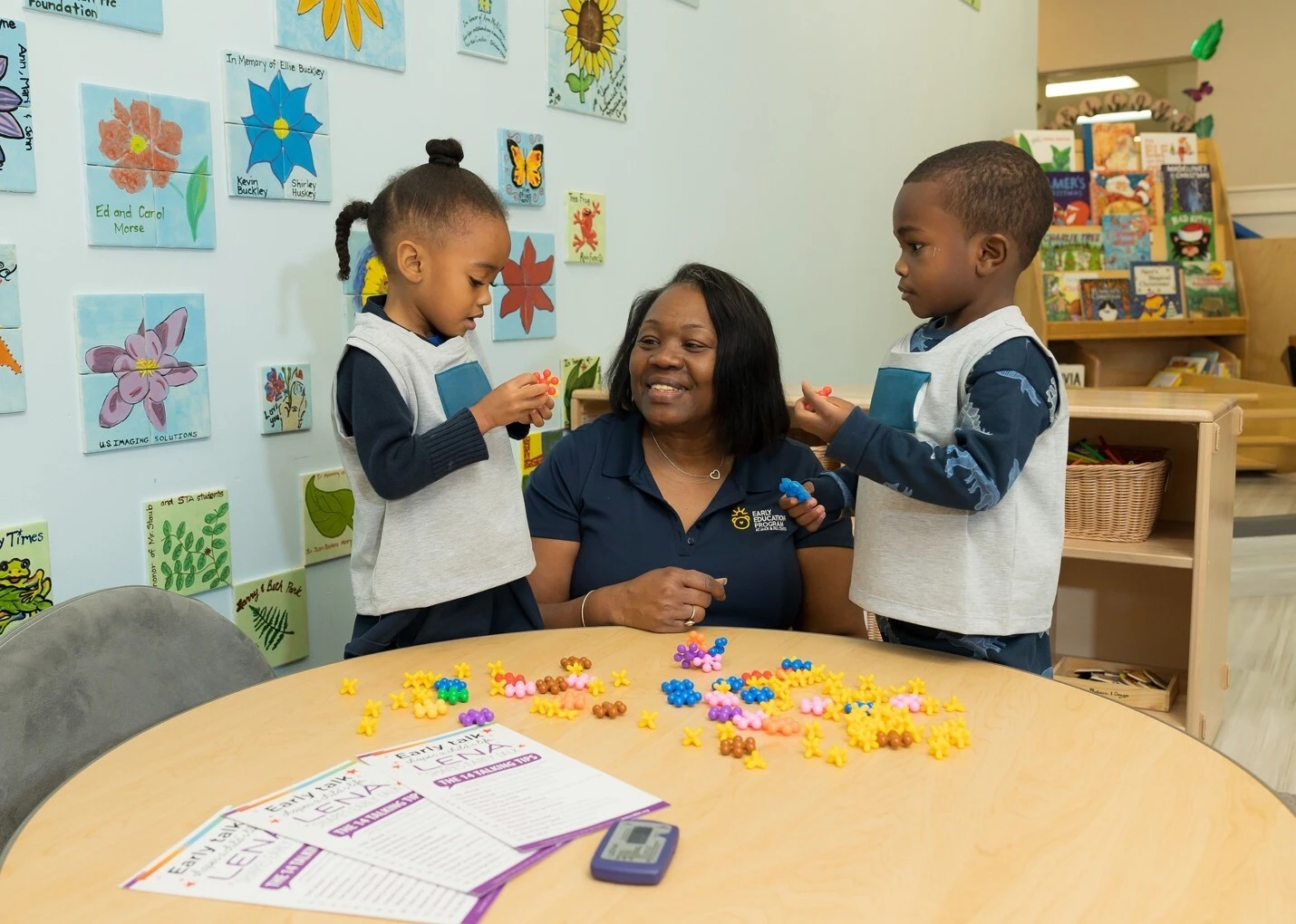
A preschool teacher at Jack and Jill Center in Fort Lauderdale, Florida, talks with two of the children in her care during a “LENA Day,” when children wear an innovative device that analyzes how much interaction they experience.
Would it surprise you to hear that one in five children in child care has almost zero verbal interaction with their teachers? That goes for infants, toddlers, and preschoolers alike. After all, reading to a baby is as much an opportunity for conversation as building blocks with a toddler or playing house with a preschooler!
How do we know? Researchers used LENA technology, sometimes called a “talk pedometer” or a “Fitbit for conversation,” to analyze how 15,820 children experience their classroom’s language environment across the U.S. Alarmingly, around 3,000 of them experienced fewer than five conversational turns per hour for the majority of the day.
It won’t surprise anyone who has logged many hours inside a classroom that responsive interactions between teachers and children in their care are among the most important components of high-quality early education. However, with widespread teacher shortages, lack of support and resources, and the overwhelming demands placed on early childhood teachers, too many children are missing out on all the positive outcomes associated with conversational turns. These interactions play a critical role in building babies’ brains, boosting their social-emotional development, supporting their executive functioning, and giving them the preliteracy skills that help them learn to read.
“Talking with young children, not just to them, may make a big difference in their lives for a long time to come,” said Dr. Jill Gilkerson, LENA’s Chief Research and Evaluation Officer. “It’s important to start early, and it’s important to amplify the critical role interactions play not just in the home, but also in child care settings.”
Greater support is needed for dual language learners
We may especially be failing our dual language learners (DLLs), particularly when they don’t have access to teachers who speak their heritage language. Additional data analysis suggests that DLLs in preschool classrooms experience around 30 percent fewer conversational turns than their monolingual peers.
Socioeconomic status (SES) has also been found to predict child care language environments. On average, children living in low-SES neighborhoods engage in fewer conversational turns than children living in high-SES neighborhoods. Though this SES effect occurs across all child care age groups, it’s most prominent for children aged 18-24 months. Alarmingly, that’s the very age range where interaction levels are most predictive of long-term outcomes, including middle school academic performance.
The bottom line is this: The more robust an early language environment is, the more likely it is to be effective at preparing children to start school strong and to learn to read.
Practical Takeaways: The 14 Talking Tips (and more!)
We wish every early childhood educator in the world could participate in LENA Grow®, which provides teachers with detailed data on the interactions each child in their classroom is experiencing and job-embedded support for increasing conversational turns. (And we’re working on it!) In the meantime, though, there are plenty of strategies for increasing conversational turns that can be put into practice today:
- The 14 Talking Tips, which have been translated into over a dozen languages, are research-based tips for increasing conversational turns. Among the most powerful of the tips: “Wait for their response.” It seems so easy, but in practice, it’s hard. The next time you say something to a toddler, see how much patience it takes to give them ample time to respond.
- For each of the Talking Tips, there are also specific strategies to use with DLLs. Tip #2 is to “comment on what they’re doing or looking at.” For dual language learners, planning to use consistent, simple language when describing everyday routines can make a big difference.
- Each Talking Tip also comes with specific ideas for organizing your classroom to encourage the most conversational turns possible. Tip #5 is: “Touch, hug, hold.” We all know the value in having a “cozy corner.” There’s no better place to cuddle up and engage in some dialogic reading.
- Speaking of dialogic reading, LENA’s Resources for Shared Reading offers fun ways to turn read-aloud time into interactive conversation time. One tip is to discuss the child’s experiences: “Remember when we walked by a dog? Was that dog as big as Clifford?”
- Finally, there are the Conversation Cards. Open-ended questions are great for encouraging conversational turns. These “mini question cards” offer questions to ask for different routines throughout the day. At mealtimes, for instance: “I am eating food that starts with a t-t-t sound. What could it be?”
Visit lena.org/resources to download these and other resources for free.
Ask your center director or CCR&R about LENA Grow
Data is powerful. We know that children benefit from more conversational turns. And we know that too many children in child care aren’t experiencing enough of them.
Early talk data allows us to pinpoint exactly how much verbal interaction children experience. That helps teachers identify accessible ways to boost interaction levels, showing who needs more interaction when.
It’s one thing to tell teachers to “just talk more.” It’s another thing altogether to give them the tools they need to recognize opportunities for conversation and to create more of them. There’s an abrupt limit to how effective is just to tell someone to change their behavior. After all, adults who talk the least actually tend to overestimate the most (that’s among parents, at least, as shown in this study).
At LENA, we’re firm believers in the mantra that you can’t improve what you don’t measure. That’s why the very same technology that researchers use to conduct all this data analysis is also available to early childhood educators through the LENA Grow professional development program. Good things happen when you put this technology directly into the hands of teachers — for the children and for the teachers themselves.